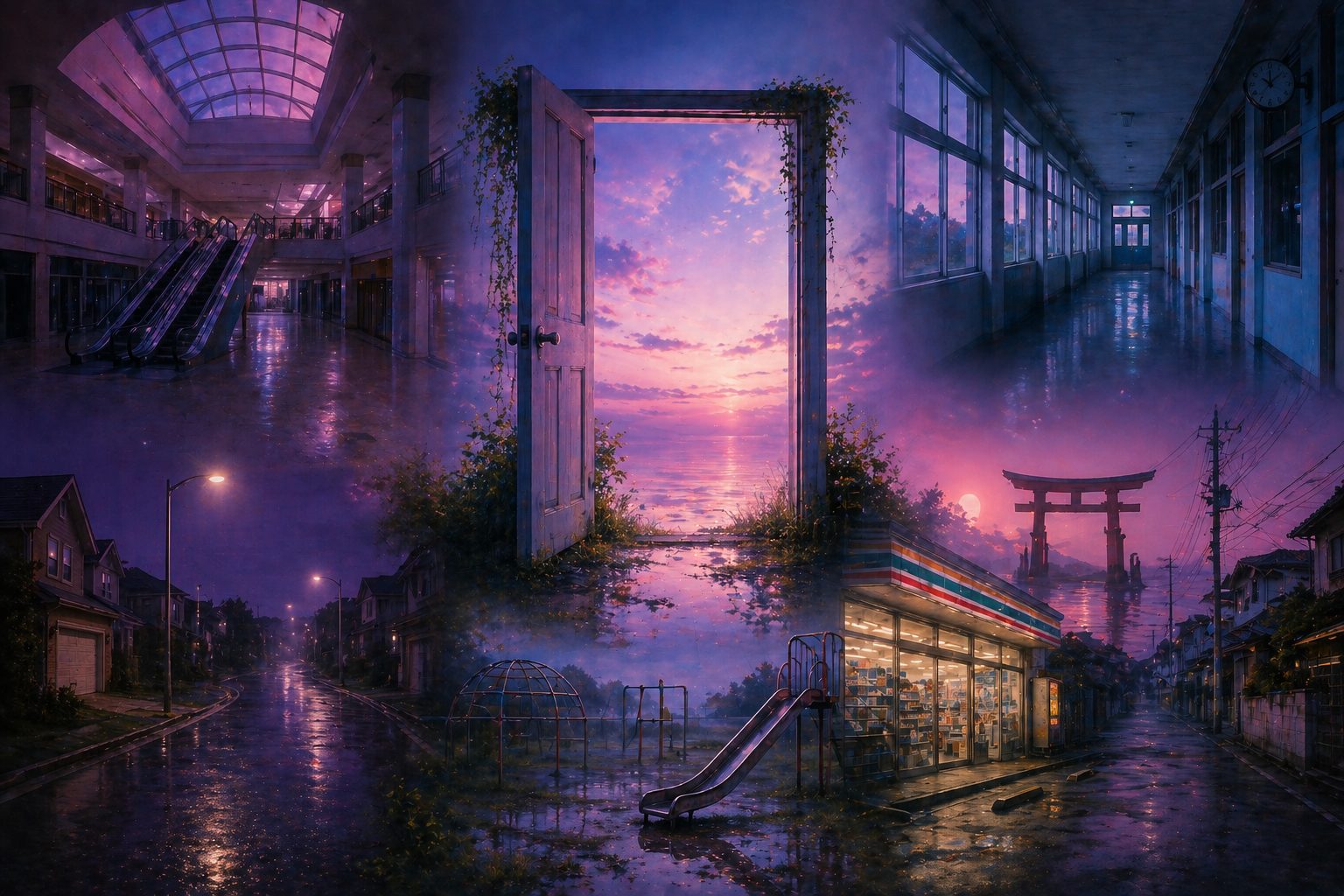
Dreamcore is often described through visuals — liminal spaces, surreal nostalgia, and dreamlike environments.
But what if the memories behind those images were never yours to begin with?
As someone who grew up in Japan, I’ve spent a lot of time looking at Dreamcore through American blogs, essays, and images — the places where this aesthetic is often said to originate.
I’m drawn to many of those images.
The atmosphere, the stillness, the quiet strangeness — I love them.
But when it comes to nostalgia, something doesn’t quite connect.
I don’t remember those places.
They were never part of my life.
And yet, I still feel something.
In this essay, I explore that subtle gap between cultures, memories, and emotions — and what Dreamcore feels like when it doesn’t fully belong to you.
Discovering Dreamcore from a Distance
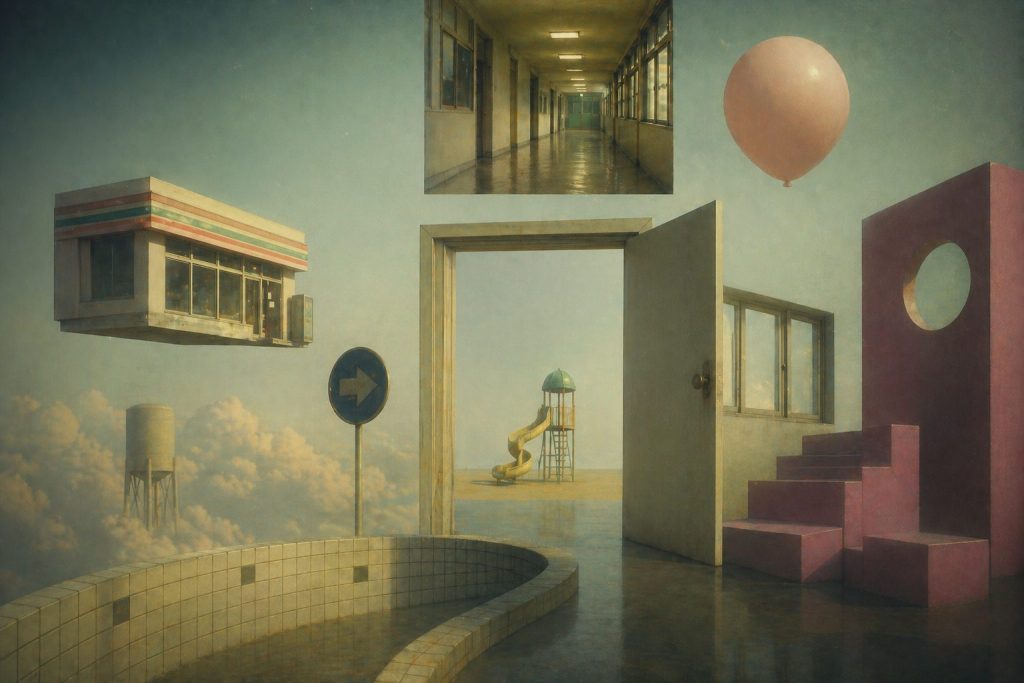
I first came across Dreamcore the way many things are discovered now — through a screen, late at night, without really looking for it.
Images of empty spaces.
Places that felt familiar, but not entirely real.
A strange stillness, as if something had just happened — or was about to.
At first, I thought I understood it.
But the more I looked, the more I realized I was seeing it from a distance.
Not just physically, but culturally. Emotionally.
A Nostalgia That Doesn’t Belong to Me
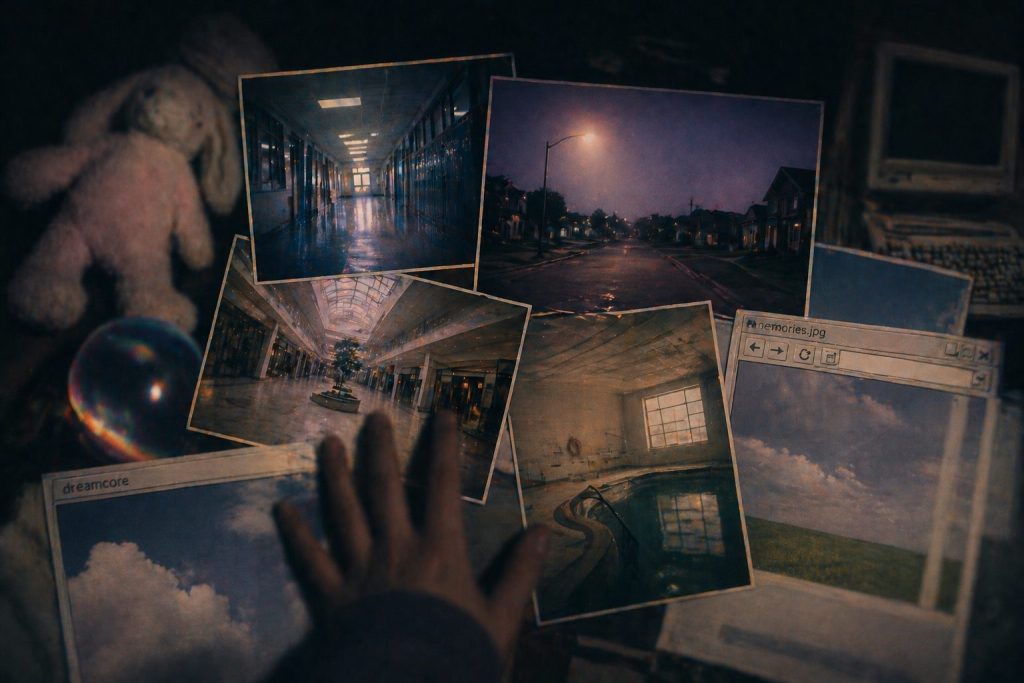
Dreamcore is often tied to a very specific kind of nostalgia.
I’ve spent a lot of time reading American blogs and essays, scrolling through images people have shared — trying to understand what they see, what they remember.
And I do feel something when I look at those images.
I like them. I’m drawn to them.
But nostalgia?
Not quite.
Those hallways, those suburbs, those empty malls — they were never part of my life.
I’m not remembering them.
I’m witnessing someone else’s memory.
What My Memories Actually Look Like
When I try to follow that feeling inward, the scenery changes.
It becomes quieter. Closer.
An empty school hallway after sunset, the sound of footsteps echoing longer than they should.
A convenience store glowing under harsh lights in the middle of the night.
A narrow street in summer, filled with the distant sound of cicadas.
These are places I’ve actually been.
And yet, when I remember them, they don’t feel entirely real either.
The edges blur.
Time feels uneven.
Something is missing — or maybe something extra is there.
An Unstable Memory
There are memories that don’t sit still.
They shift depending on how you look at them.
They feel different depending on when you remember them.
Sometimes I’m not sure if something really happened, or if I just dreamed it once and kept it.
That uncertainty feels close to Dreamcore.
Not the images themselves — but the instability behind them.
The Gap Between Cultures and Emotions
The difference becomes clearer when you look at the spaces themselves.
American Dreamcore (Typical Imagery)
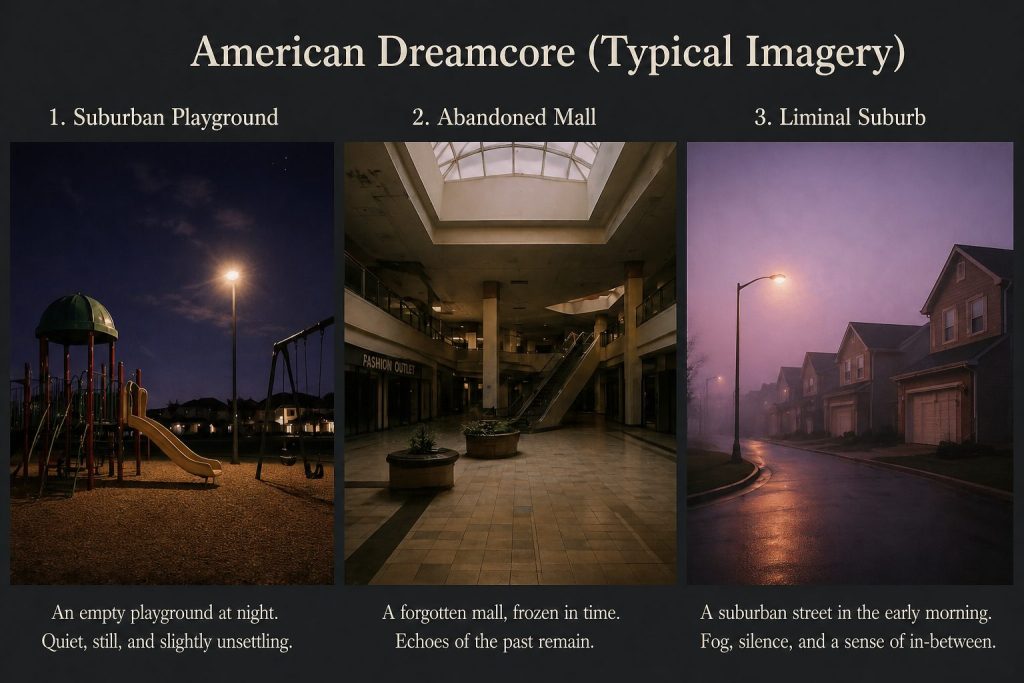
Japanese Dreamcore (Personal / Cultural Variation)
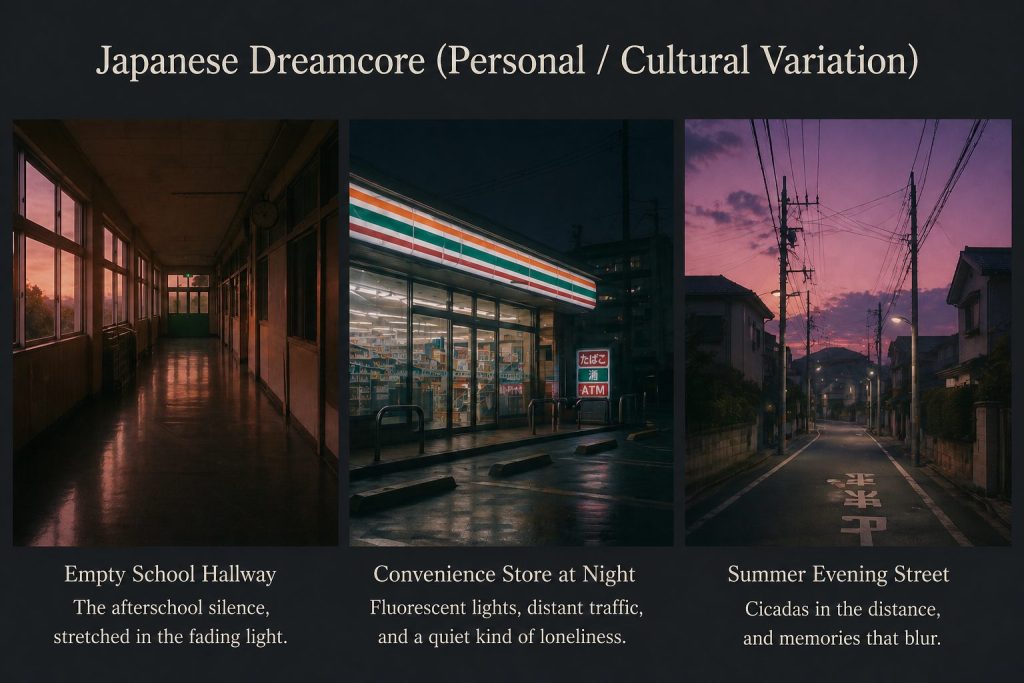
The structures are different. The atmosphere shifts.
And yet, the feeling — strangely — overlaps.
Dreamcore, as I first encountered it, carries traces of American culture — its spaces, its architecture, its everyday life.
But feelings don’t belong to one place.
The imagery travels easily.
The emotion… translates, but not perfectly.
I recognize the mood.
But the memory attached to it is missing.
And in that gap, something new forms.
Why Dreamcore Still Resonates
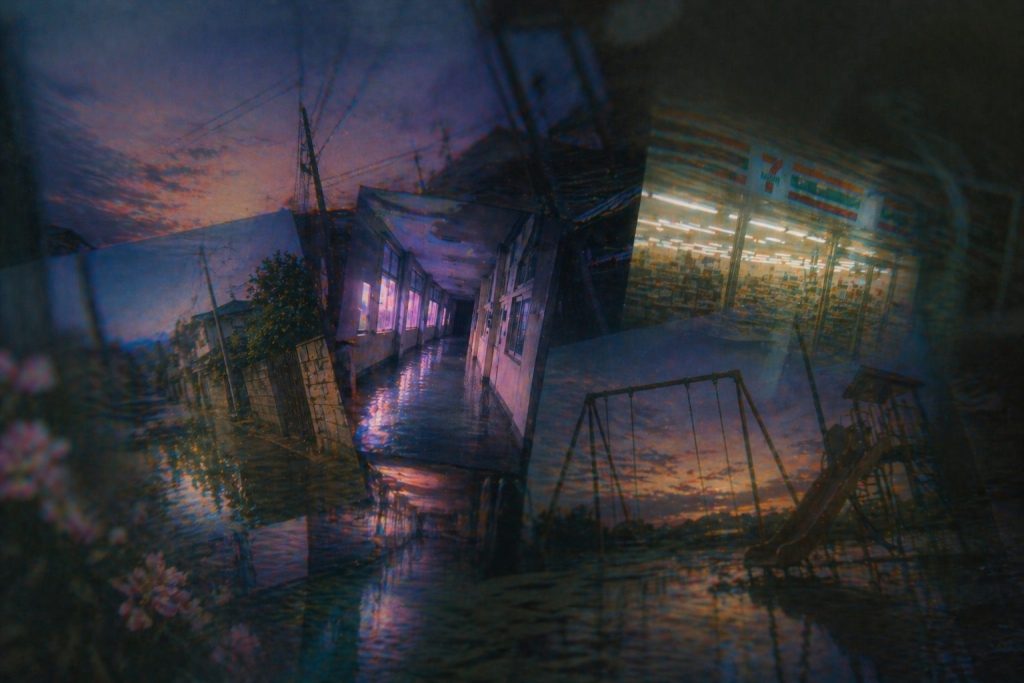
Even without shared memories, something still connects.
A feeling of being somewhere you almost recognize.
A sense that something is slightly off, but not enough to break the illusion.
A quiet mix of comfort and unease.
These aren’t tied to any one country.
They exist in small moments — in pauses, in silence, in things that are almost forgotten.
Maybe that’s why Dreamcore works across cultures.
Not because we remember the same things,
but because we experience the same kind of uncertainty.
My Version of Dreamcore
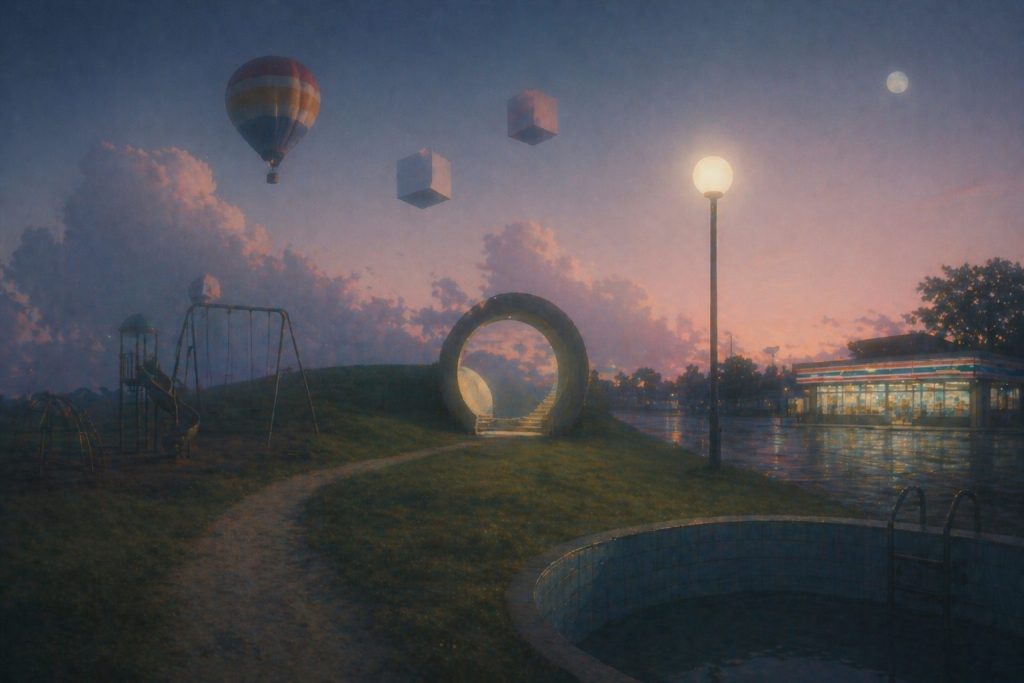
If I try to define my own version of Dreamcore, it wouldn’t look exactly like the images I first saw.
It would feel more humid.
More grounded, but also more suffocating in a quiet way.
It would have sound — the low hum of vending machines, distant traffic, insects in the dark.
It wouldn’t be empty.
Just… slightly disconnected.
Not a dream, and not a memory.
Something that exists between the two.
Dreamcore as an In-Between Space
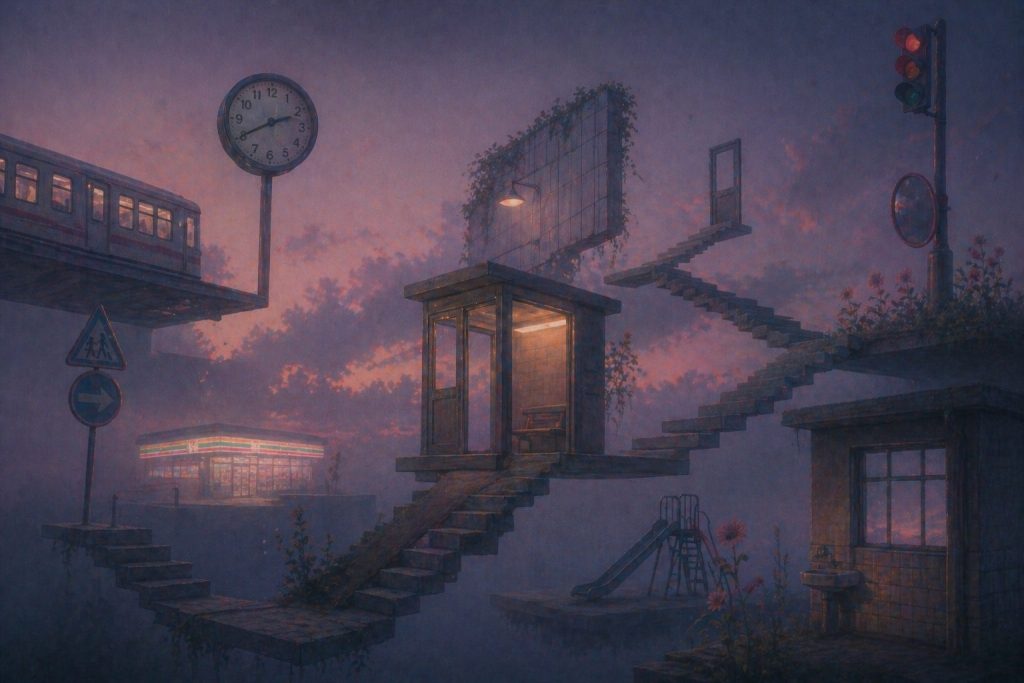
I used to think I needed to understand Dreamcore correctly.
To match the images, the meanings, the nostalgia.
But now I think it exists precisely in that space where things don’t match.
Between cultures.
Between memories.
Between what is real and what only feels real.
You don’t need the same past to feel it.
You just need that small, quiet sense that something is there —
just out of reach.
And maybe, just to bring this back to where I am now—
I’m Japanese, but I’ve always been drawn to what people call “internet aesthetics.”
I’ve spent years looking at images, reading posts, and exploring fragments of culture shared online by people from the U.S. and beyond.
There’s always been a small gap between what I see and what I personally remember.
But I’ve come to appreciate that distance, rather than trying to close it.
Recently, I started creating videos inspired by these aesthetics and sharing them on YouTube.
I read through forums and blogs, collecting small details and impressions,and use generative AI as a tool to piece them together — slowly, carefully.
Of course, some people might feel that something is slightly off,or think, “this belongs to a different aesthetic.”
And I think that’s a natural part of it.
These spaces were never meant to be exact.
They exist somewhere between interpretation and memory.
So if you enjoy this kind of atmosphere —
and if you’re open to how generative tools can be part of that process —
you might find something there.


Comment